HR & Employment
Free Termination Letter Template (PDF)
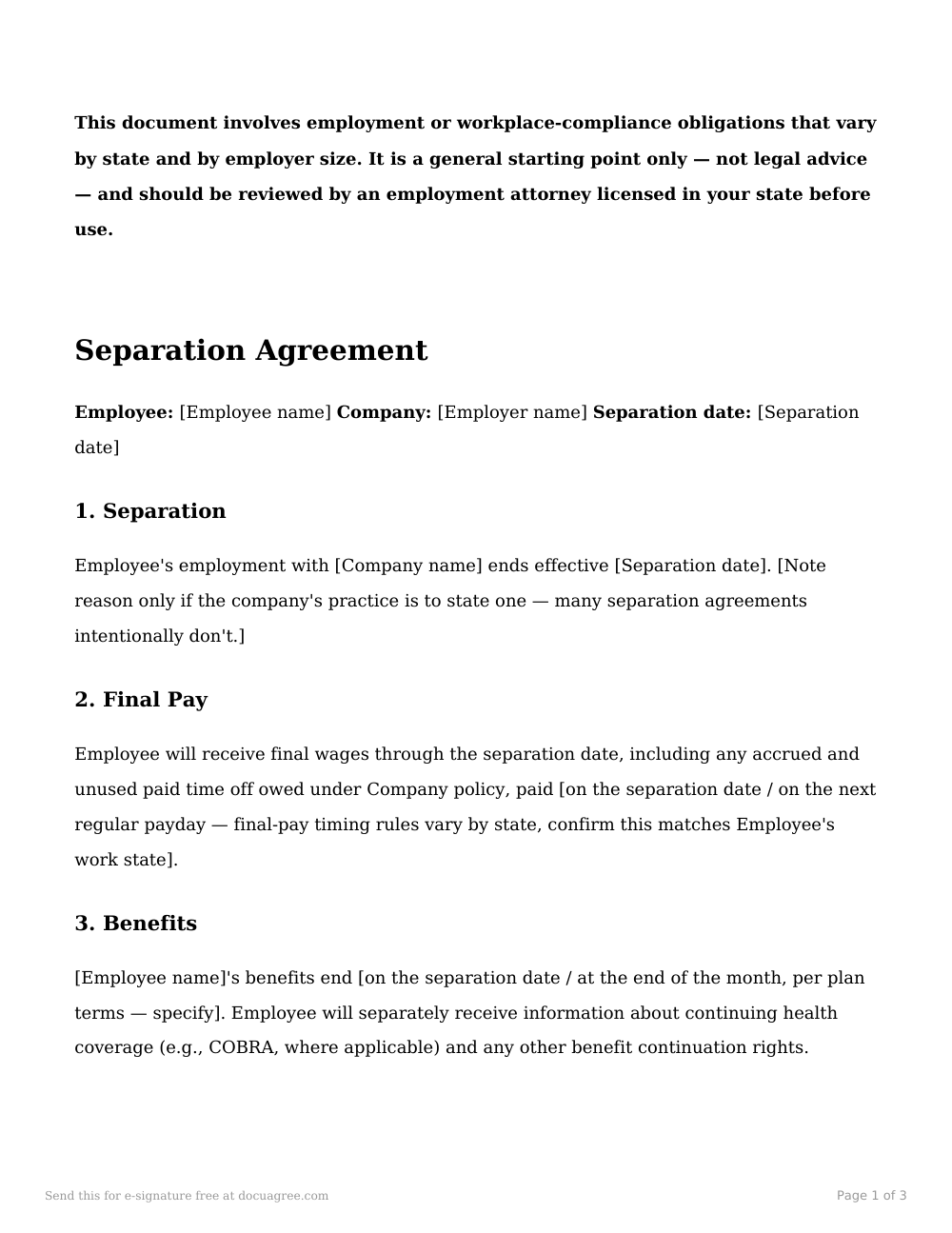
A termination letter or separation agreement documents the end of an employment relationship — the separation date, final pay, return of company property, and, if severance is offered, the terms of a release of claims.
Download the template
Free, no signup required. Fill in the blanks by hand, or use it below to fill and send for signature.
When to use it
Use this any time an employment relationship ends, to put the practical details (final pay, property return, benefits) in writing — and use it especially carefully if severance and a release of claims are involved, since that section carries real legal requirements that a generic template can't substitute for.
What's typically included
- Separation date
- Final pay
- Benefits continuation
- Return of company property
- Severance (if offered)
- Release of claims (if severance is offered)
- Confidentiality and non-disparagement
- Governing law
How to fill it in
- Confirm the final-pay timing against the employee's work state before filling it in — many states require final wages on the separation date itself or within a short, specific window, stricter than a "next regular payday" default.
- If no severance is being offered, delete the severance and release-of-claims sections entirely rather than leaving placeholder text — those sections only make sense together, and only when severance is actually on the table.
- If severance and a release of claims are involved, do not rely on this template's bracketed language for that section — have an employment attorney draft or review it specifically. A valid release has real legal requirements that vary by claim type and state, and federal law (the Older Workers Benefit Protection Act) imposes specific review and revocation periods for a release covering age-discrimination claims from an employee 40 or older.
This document involves employment or workplace-compliance obligations that vary by state and by employer size. It is a general starting point only — not legal advice — and should be reviewed by an employment attorney licensed in your state before use.
Frequently asked questions
Can I use this template's release-of-claims language as-is?
No — this is the one section of this template you should not use generic bracketed language for. A valid release has real legal requirements that vary by claim type and by state, including specific review and revocation periods under federal law (the Older Workers Benefit Protection Act) for a release covering age-discrimination claims from an employee 40 or older. Have an employment attorney draft or review this section before using it.
When does an employee have to receive their final paycheck?
This varies by state — some states require final wages on the separation date itself, others allow the next regular payday, and the rule can even differ depending on whether the separation was voluntary or involuntary. Confirm the specific requirement for the employee's work state before finalizing this section.
Is an electronically signed separation agreement legally binding?
Yes, an electronic signature is generally treated the same as one on paper under the U.S. ESIGN Act and state UETA laws — though if the agreement includes a release covered by the Older Workers Benefit Protection Act, confirm the required review period is honored regardless of signing method.
Ready to use this template?
Every word is editable before you send — this is a starting point, not a final draft.