HR & Employment
Free Employee NDA Template (PDF)
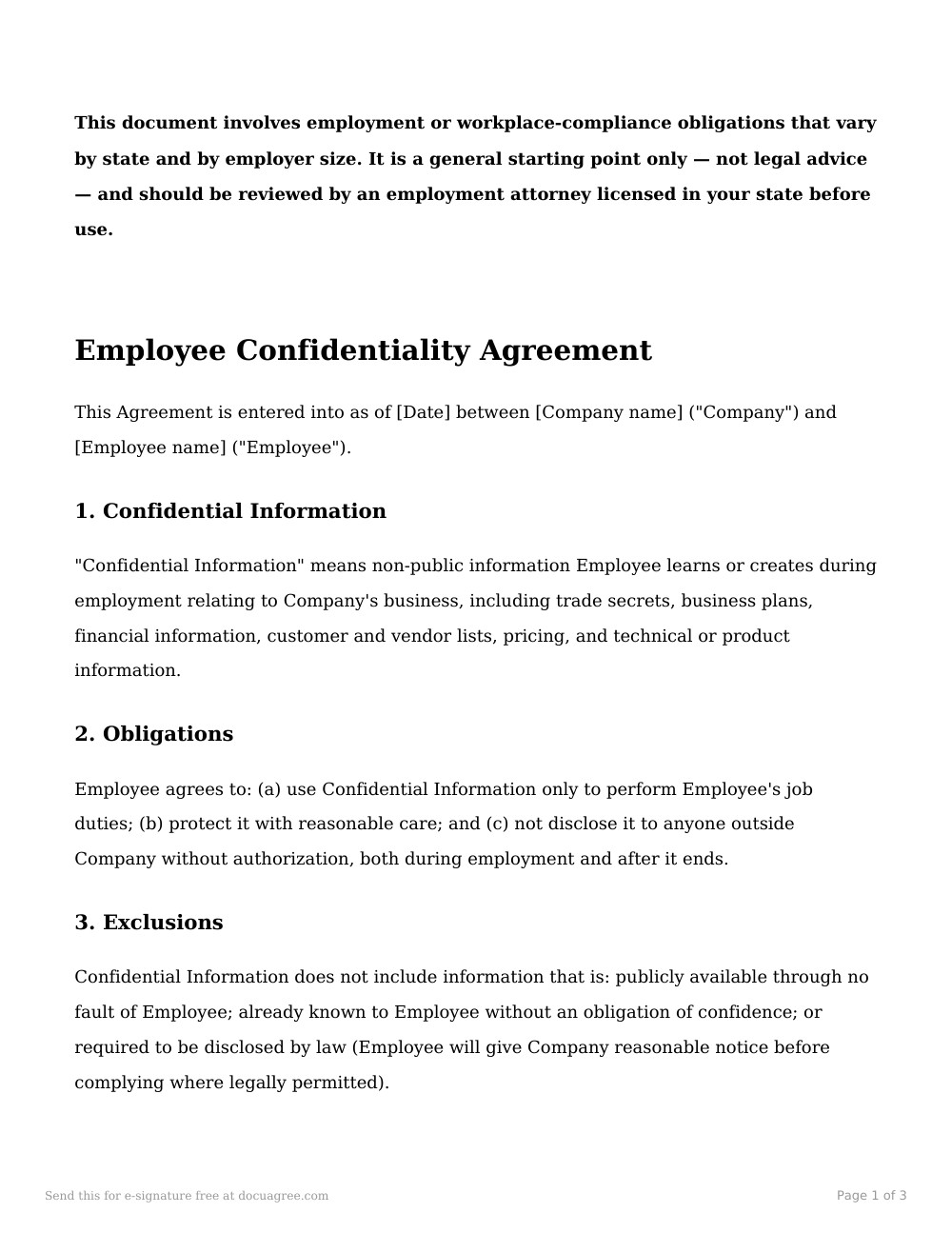
An employee confidentiality agreement is an employee-specific NDA — an ongoing duty to protect the employer's trade secrets, business plans, and customer information, both during employment and after it ends.
Download the template
Free, no signup required. Fill in the blanks by hand, or use it below to fill and send for signature.
When to use it
Use this for any employee who'll have access to real business-sensitive information — customer lists, pricing, product plans, or trade secrets — distinct from a one-off NDA because the obligation is meant to last for the whole employment relationship and beyond.
What's typically included
- Definition of confidential information
- Employee obligations
- Exclusions
- Protected activity carve-out
- Return of materials
- Remedies
- Governing law
How to fill it in
- Fill in the company name throughout and confirm the definition of confidential information actually matches what this employee will have access to — an overly broad definition can be harder to enforce than a specific one.
- Keep the protected activity carve-out in the document as written — it exists so this agreement doesn't (and legally can't) prevent an employee from reporting violations of law to a government agency or discussing wages and working conditions with coworkers.
- This is best signed at the start of employment, alongside an offer letter or employment agreement, rather than introduced later — obligations agreed to only after someone already has access to sensitive information carry more legal and practical friction.
This document involves employment or workplace-compliance obligations that vary by state and by employer size. It is a general starting point only — not legal advice — and should be reviewed by an employment attorney licensed in your state before use.
Frequently asked questions
How is this different from a regular NDA?
A standalone NDA is typically for a specific external relationship (a vendor, a prospective partner) with a defined purpose and often a set term. This agreement is employee-specific, tied to the employment relationship itself, and its confidentiality obligations are meant to continue after employment ends, not expire after a fixed number of years.
Can this agreement stop an employee from reporting something illegal to a regulator?
No — the protected activity section specifically preserves an employee's right to report possible violations of law to a government agency, participate in a government investigation, or discuss wages, hours, and working conditions with coworkers, to the extent protected by law. Removing that carve-out isn't recommended, since these protections generally exist regardless of what a private agreement says.
Is an electronically signed confidentiality agreement legally binding?
Yes, under the U.S. ESIGN Act and state UETA laws, the same as any other contract.
Ready to use this template?
Every word is editable before you send — this is a starting point, not a final draft.