Confidentiality & Legal
Free One-Way NDA Template (PDF)
A one-way (unilateral) NDA is a confidentiality agreement where only one party is disclosing sensitive information and only the other party takes on confidentiality obligations — simpler than a mutual NDA because the protection only runs in one direction.
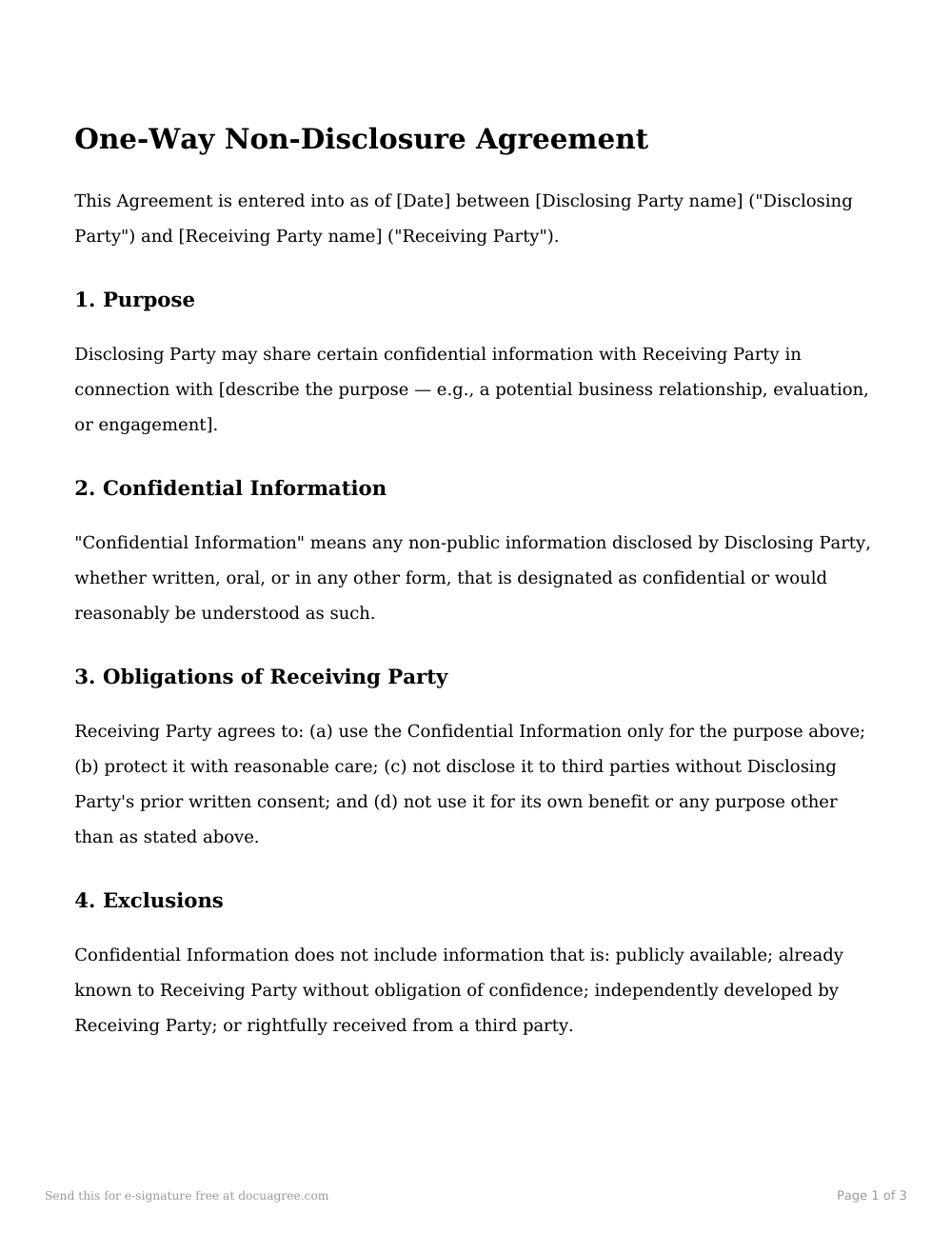
Download the template
Free, no signup required. Fill in the blanks by hand, or use it below to fill and send for signature.
When to use it
Use a one-way NDA when only one side is actually sharing something sensitive — briefing a job candidate on internal plans, sharing proprietary information with a potential customer during a sales process, or any situation where the flow of confidential information is genuinely one-directional.
What's typically included
- Purpose of the disclosure
- Definition of confidential information
- Receiving party's obligations
- Exclusions
- Term
- No obligation to proceed
- Governing law
How to fill it in
- Double-check which role is which before sending — Disclosing Party is the one sharing information and has no confidentiality obligations under this document; Receiving Party is the one bound by them.
- Describe the purpose specifically (e.g., "evaluating a potential vendor relationship") so it's clear what the Receiving Party is, and isn't, allowed to use the information for.
- Set the survival period to match how long the information actually needs protecting — a short-lived business detail doesn't need the same multi-year tail as a trade secret.
This template is a general starting point, not legal advice — customize it and have it reviewed for your situation.
Frequently asked questions
Who should sign as the Receiving Party?
Whoever is actually being given access to the confidential information and needs to be bound to protect it — a candidate, prospective customer, or contractor, for example. The Disclosing Party is whoever owns the information being shared.
Is an electronically signed one-way NDA legally binding?
Yes, under the U.S. ESIGN Act and state UETA laws, the same as a mutual NDA or any other contract.
Can I use this if both sides might end up sharing something sensitive?
Not ideally — if there's a real chance the flow goes both directions, use the mutual NDA instead, since a one-way NDA leaves the Disclosing Party's own confidentiality unprotected if roles end up reversing.
Ready to use this template?
Every word is editable before you send — this is a starting point, not a final draft.