Confidentiality & Legal
Free Mutual NDA Template (PDF)
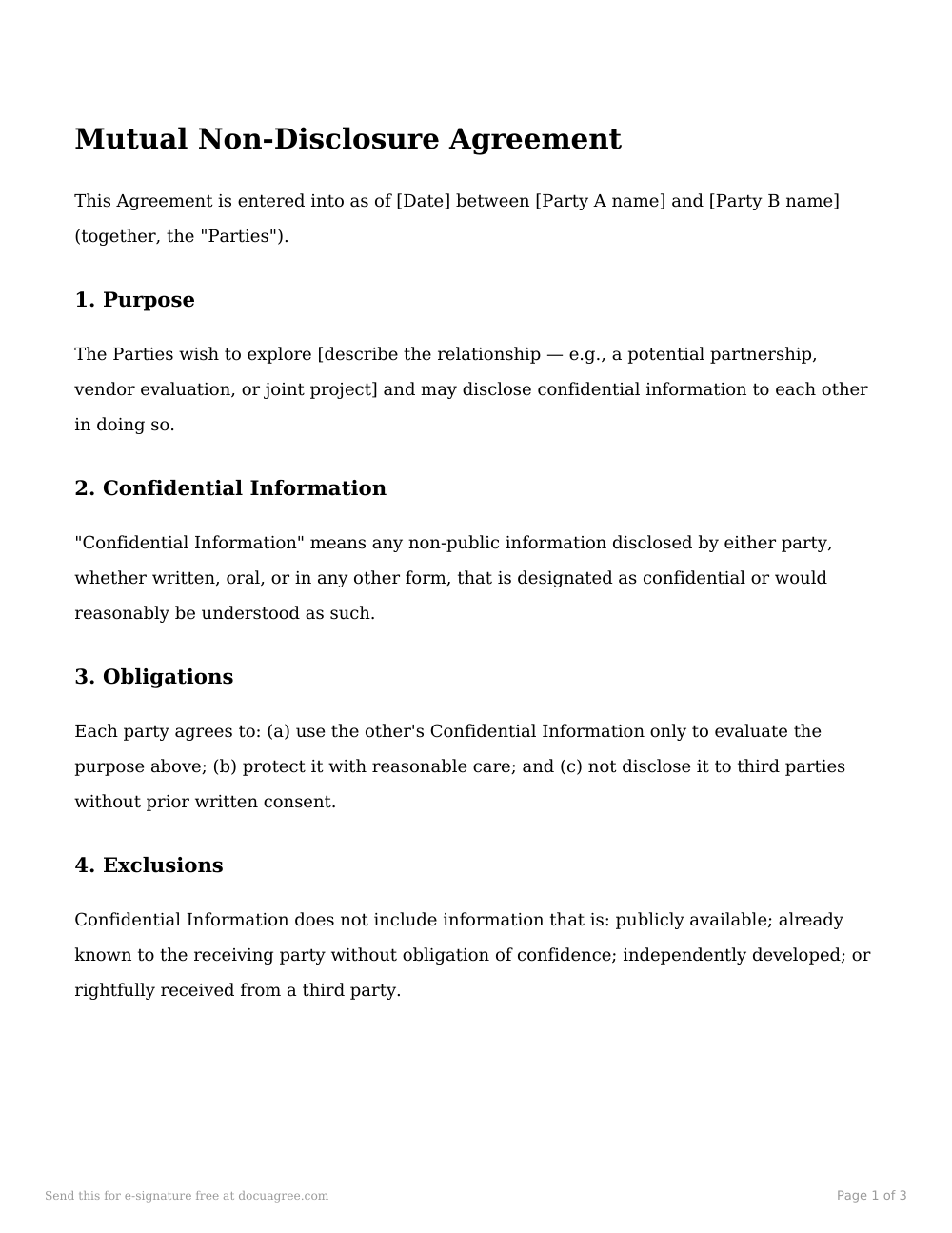
A mutual non-disclosure agreement (NDA) is a two-way confidentiality contract — both parties may share sensitive information, and both are bound to protect what the other discloses.
Download the template
Free, no signup required. Fill in the blanks by hand, or use it below to fill and send for signature.
When to use it
Use a mutual NDA whenever both sides will be revealing something sensitive during a conversation — partnership discussions, vendor evaluations, or any joint exploration where each party has real information at stake, not just one.
What's typically included
- Purpose of the disclosure
- Definition of confidential information
- Obligations of both parties
- Exclusions (public, independently known, etc.)
- Term
- No obligation to proceed with a deal
- Governing law
How to fill it in
- Fill in the purpose sentence specifically (what you're actually discussing) rather than leaving it generic — a vague purpose makes it harder to argue later that something disclosed outside that scope was ever covered.
- Set the confidentiality term and the survival period (how long obligations last after the agreement ends) as real numbers — "2 years" and "3 years" are common defaults, but shorter or longer can matter a lot depending on how sensitive the information is.
- This is the template to reach for if both sides are sharing something real — if only one side is disclosing anything sensitive, the one-way NDA is the simpler, more appropriate fit.
This template is a general starting point, not legal advice — customize it and have it reviewed for your situation.
Frequently asked questions
What's the difference between a mutual and a one-way NDA?
A mutual NDA protects information from both parties equally, since both sides are disclosing something sensitive. A one-way NDA only obligates the receiving party, because only one side is sharing confidential information. Using a mutual NDA when only one party is disclosing anything just adds unnecessary obligations to the party that isn't.
Is an electronically signed NDA legally binding?
Yes — under the U.S. ESIGN Act and state UETA laws, an electronic signature on an NDA carries the same legal weight as a signature on paper, as long as both parties agreed to sign electronically.
Does this NDA stop the other party from ever using similar information?
No — the exclusions section specifically carves out information that's already public, already known independently, or received from someone else without restriction. An NDA only protects the specific confidential information actually disclosed under it, not general knowledge or skills.
Ready to use this template?
Every word is editable before you send — this is a starting point, not a final draft.