Real Estate & Rentals
Free Residential Lease Agreement Template (PDF)
A residential lease agreement is the contract between a landlord and a tenant for renting a home or apartment — it sets the rent, the term, the security deposit, who pays which utilities, who handles repairs, and how either side can end the tenancy.
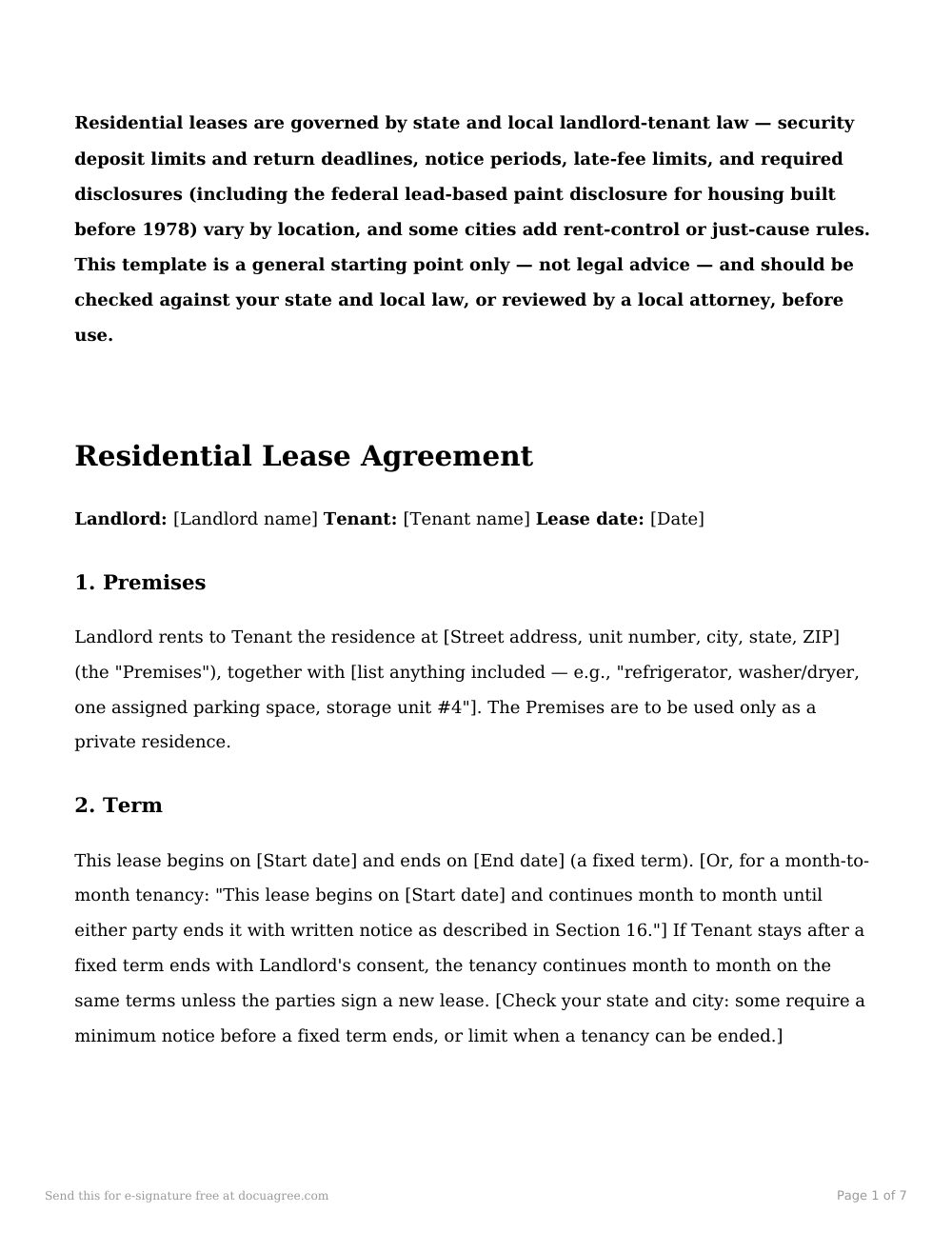
Download the template
Free, no signup required. Fill in the blanks by hand, or use it below to fill and send for signature.
When to use it
Use a residential lease whenever you rent out a house, apartment, condo, or room to someone who will live there — a fixed-term lease (usually a year) or a month-to-month tenancy. It's written for small landlords renting out one or a few units themselves. If you're a licensed agent, your state association's required forms usually take precedence; and because landlord-tenant law varies so much by state and city, every state-sensitive term in this template is left as a prompt for you to check, not filled in with a number.
What's typically included
- Premises and what's included (appliances, parking, storage)
- Fixed-term or month-to-month term
- Rent, due date, and payment method
- Late fees and returned payments
- Security deposit and its return
- Utilities and services
- Occupants and guests
- Use of the premises and building rules
- Pets, with assistance animals handled separately
- Maintenance and repairs
- Alterations
- Landlord's entry and notice
- Subletting and short-term rentals
- Smoking
- Renters insurance
- Ending the tenancy and moving out
- Default (no lockouts or self-help eviction)
- Required disclosures, including federal lead-based paint disclosure
- Notices
- Joint responsibility of co-tenants
- Entire agreement and changes
- Governing law
- Signature blocks for landlord and tenant
How to fill it in
- Look up your state's rules before filling in the deposit, late-fee, entry-notice, and move-out-notice blanks: many states cap the deposit (often one to two months' rent), set a deadline for returning it, limit late fees, and require a minimum notice before entering or ending a month-to-month tenancy. Some cities add rent-control or just-cause eviction rules on top.
- If the home was built before 1978, attach the federal lead-based paint disclosure form and give the tenant the EPA pamphlet before they sign — it's required by federal law, not just recommended.
- Do a move-in walkthrough with the tenant and attach a signed condition checklist with photos. It's the strongest evidence you'll have when deciding what counts as damage versus normal wear and tear at move-out.
- Add every adult tenant as a signer. With more than one tenant on the lease, each is responsible for the full rent, which protects you if one roommate leaves.
Residential leases are governed by state and local landlord-tenant law — security deposit limits and return deadlines, notice periods, late-fee limits, and required disclosures (including the federal lead-based paint disclosure for housing built before 1978) vary by location, and some cities add rent-control or just-cause rules. This template is a general starting point only — not legal advice — and should be checked against your state and local law, or reviewed by a local attorney, before use.
Frequently asked questions
Can a residential lease be signed electronically?
Yes. Under the U.S. ESIGN Act and state UETA laws, an electronically signed lease is as valid as a paper one, as long as both parties agree to sign electronically. DocuAgree records each signer's consent and produces a certificate of completion with the signed lease.
How much can I charge for a security deposit?
It depends on your state. Many states cap security deposits, commonly at one or two months' rent, and some count pet deposits toward that cap; others set no limit. States also set a deadline for returning the deposit after move-out, typically somewhere between two weeks and two months, usually with an itemized list of deductions. Check your state's rule before filling in the amount.
Can I charge a pet deposit for an emotional support or service animal?
Generally no. Under the federal Fair Housing Act, an assistance animal needed because of a disability is not a pet, so pet deposits, pet rent, and pet fees don't apply to it, although the tenant is still responsible for any damage it causes. This template keeps assistance animals separate from its pet clause for that reason.
Do I need a lead paint disclosure?
If the home was built before 1978, yes. Federal law requires the landlord to disclose any known lead-based paint or hazards, give the tenant the EPA pamphlet "Protect Your Family From Lead in Your Home," and attach a signed disclosure form to the lease. Your state or city may require other disclosures too, such as mold, flood zone, or bedbug history.
Is this lease valid in every state?
It's written as a general starting point that avoids clauses courts commonly refuse to enforce, but it isn't a state-specific form. Landlord-tenant law varies widely, and where it conflicts with the lease, the law wins. Check it against your state and local rules, or have a local attorney review it, before you use it.
Ready to use this template?
Every word is editable before you send — this is a starting point, not a final draft.