Policies & Compliance Acknowledgments
Free Cybersecurity Policy Template (PDF)
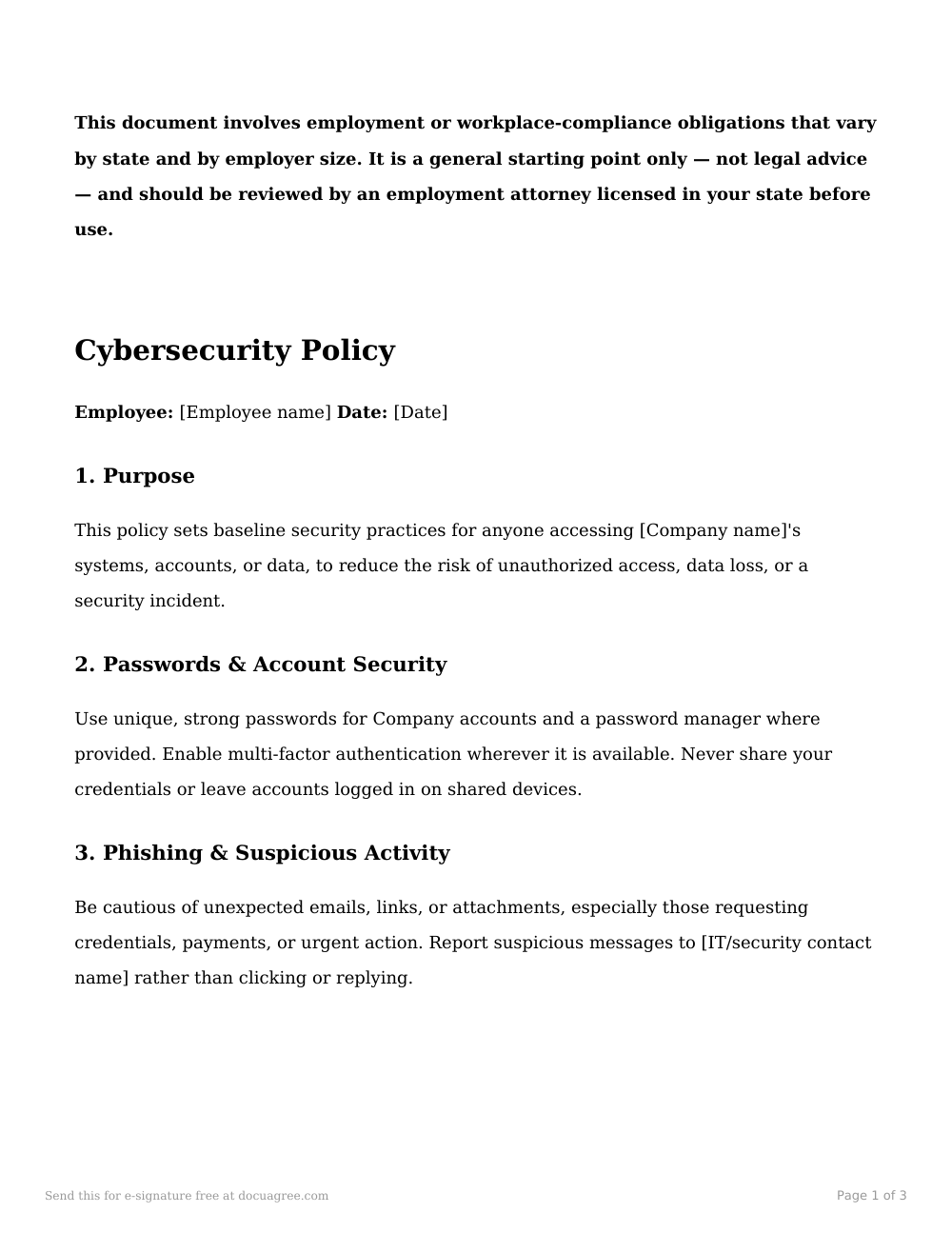
A cybersecurity policy acknowledgment documents that an employee has read and agreed to a company's baseline security practices — passwords, phishing awareness, and incident reporting — with a signature confirming they'll follow it.
Download the template
Free, no signup required. Fill in the blanks by hand, or use it below to fill and send for signature.
When to use it
Use this as part of onboarding, or whenever you roll out or update baseline security expectations — having every employee formally acknowledge the policy makes those expectations enforceable, not just implied.
What's typically included
- Purpose
- Password and account security
- Phishing and suspicious activity
- Software and updates
- Incident reporting
- Consequences of non-compliance
- Employee acknowledgment
How to fill it in
- Fill in the real IT/security contact name in the phishing and incident-reporting sections — a policy that tells someone to "report it" with no named contact tends not to get followed in practice.
- Have every employee re-sign when the policy is meaningfully updated (a new MFA requirement, a new approved-software process), not just once at hire — this is what shows a given employee agreed to the current rules, not an outdated version.
- This is a baseline policy, not a full security program — if your company handles regulated data (health, payment card, financial), you likely need additional, more specific policies on top of this one.
This document involves employment or workplace-compliance obligations that vary by state and by employer size. It is a general starting point only — not legal advice — and should be reviewed by an employment attorney licensed in your state before use.
Frequently asked questions
Is this acknowledgment enough to meet a specific compliance requirement (SOC 2, HIPAA, PCI)?
Not on its own — this covers baseline employee security practices, which is typically one piece of a larger compliance program. Frameworks like SOC 2, HIPAA, or PCI DSS have their own specific documentation and control requirements beyond a single acknowledgment form.
Is an electronically signed policy acknowledgment legally binding?
Yes, under the U.S. ESIGN Act and state UETA laws, an electronic signature and checkbox confirmation carry the same legal weight as a signature on paper.
What if an employee violates this policy — what can the company actually do?
The consequences section states that violations may result in corrective action up to and including termination — having a signed acknowledgment on file supports that action by showing the employee was clearly informed of the expectation beforehand.
Ready to use this template?
Every word is editable before you send — this is a starting point, not a final draft.